


Blog

Aug 25, 2026
The Returns Relay: How Two Boxes and Happy Returns Power a Best-in-Class Reverse Logistics Stack for Enterprise Retailers
Returns have long been treated as a cost center - a line item to minimize rather than an experience and operation to design. But for enterprise retailers processing returns at scale, the reality is more nuanced. The journey from return initiation to restock is where customer retention, recovered margin, managing fraud, and operational efficiency are won or lost.
No single solution owns that entire journey. And too often, the gaps between solutions and the handoffs are exactly where returns programs lose value.
Happy Returns, a UPS Company, and Two Boxes have partnered to connect the shopper-facing return experience with warehouse receiving and grading, giving enterprise retailers and 3PLs a faster, more connected path from return initiation to restocked inventory.
How do shoppers initiate and drop off a return with Happy Returns?
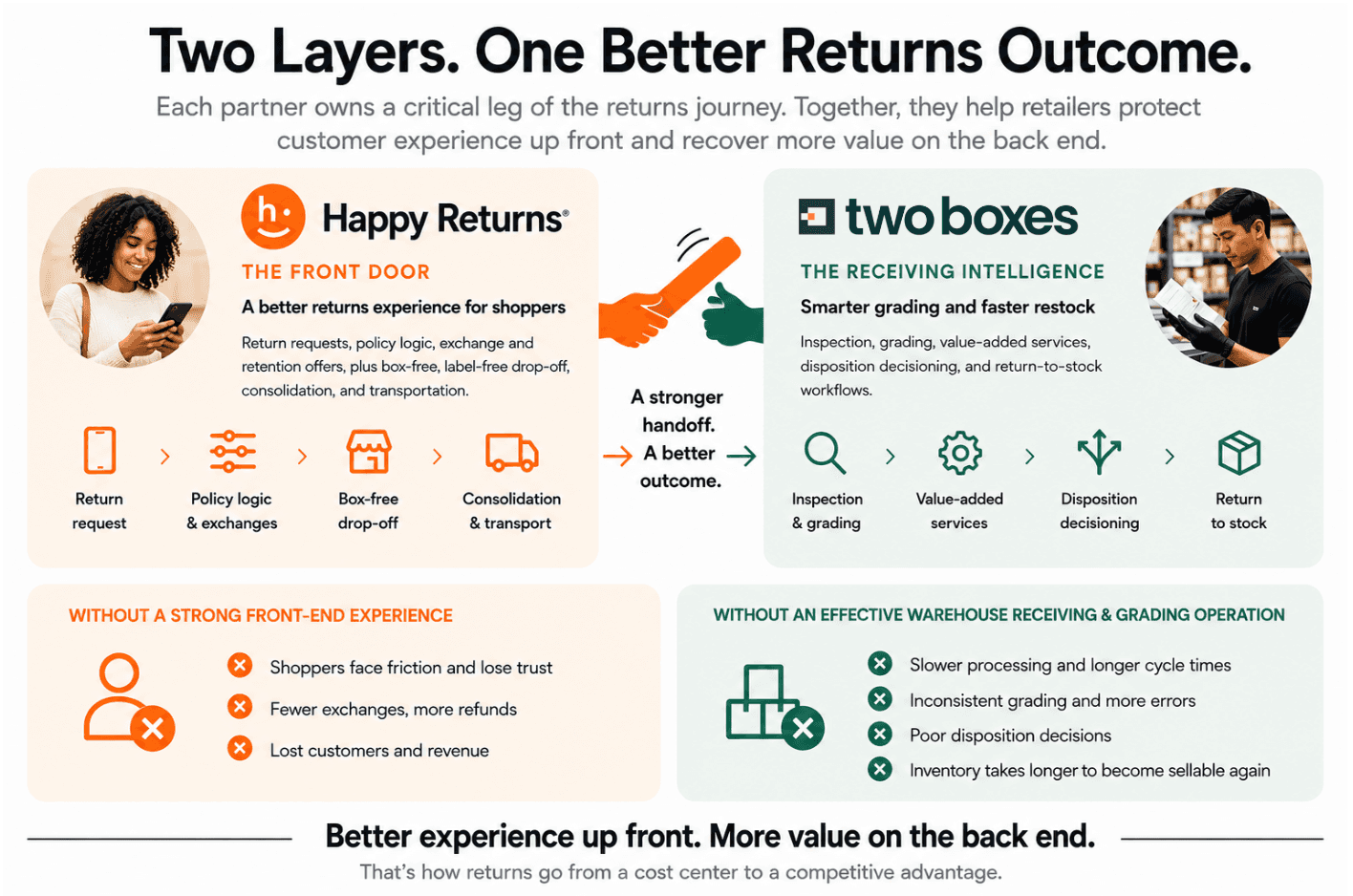
Happy Returns serves as the front door of the returns journey, delivering a seamless returns experience from initiation through reverse logistics. Retailers can power return initiation through the Happy Returns Return & Exchange Portal, their own existing return portal, or a partner portal, applying return policies and offering exchange and retention experiences designed to preserve revenue while keeping things low-friction for shoppers.
For in-person returns, the Happy Returns Return Bar® network gives shoppers access to more than 10,000 locations nationwide, including The UPS Store, Staples, and Ulta Beauty, where their returns can be dropped off box-free and label-free. Each drop-off is scanned and verified in real time, with behavioral risk scoring flagging returns that need a closer look before a refund is approved.
From there, Happy Returns manages the physical journey. Returns are consolidated and transported to Happy Returns hubs, where they are sorted and routed back into the retailer’s logistics network in bulk.
For enterprise retailers, bringing the digital and physical return journeys together can be especially valuable at scale. A simpler experience reduces friction for shoppers, while consolidation and streamlined reverse logistics help retailers manage high return volumes more efficiently and regain visibility into inventory moving through the returns network.
What does Two Boxes do once a return reaches the warehouse?
Once the returned product reaches the retailer’s warehouse, Two Boxes takes the baton.
Two Boxes power the receiving intelligence layer: inspection, grading, value-added services, disposition decisioning, and return-to-stock workflows.
This is where a significant portion of a retailer’s recoverable margin is determined. Grading accuracy, associate productivity, and disposition rules influence whether an item quickly returns to sellable inventory, is routed for value-added services, moves to another recovery channel, or is written off.
At enterprise scale, small improvements at this stage compound quickly. Faster processing gets inventory back into circulation sooner. More consistent grading helps retailers recover more value. Better workflow orchestration gives operators greater control over labor, throughput, and SLAs.
The two layers solve distinct but complementary problems. Without a strong front-end returns experience, retailers risk losing customers and revenue to unnecessary friction. Without an effective warehouse receiving and grading operation, they risk losing margin to slow processing, inconsistent grading, poor disposition decisions, and inventory that takes too long to become sellable again.
Why the Full Stack Matters
For brands and retailers, an integrated returns stack protects more than operational efficiency. It supports shopper experience, retention, exchange revenue, inventory recovery, and brand trust. A return is often one of the last interactions a shopper has with a brand and so it must be optimized to drive loyalty; according to the “2025 Retail Returns Landscape” report published by Happy Returns, 71% of shoppers say that a poor returns experience will make them less likely to shop with that retailer again.
For 3PLs, the value shows up differently: labor efficiency, throughput, SLA performance, and margin per return. Just as importantly, a sophisticated returns operation gives 3PLs an opportunity to offer enterprise brands a differentiated service rather than treating returns as a generic warehouse capability.
The strongest reverse logistics programs optimize for both sides at once: a better experience for the shopper and better economics once the product comes back.
Fighting Return Fraud Across the Journey
Fraud is one of the clearest examples of why that connected view matters. No single layer sees the entire picture.
Signals that indicate fraud risk emerge throughout the journey:
At initiation: return-rate anomalies, repeat behavior, and suspicious return patterns
At drop-off: discrepancies between what was expected and what physically brought for drop off
At grading: item mismatches, condition discrepancies, and product swaps
Viewed independently, these signals tell only part of the story. Connected across the return lifecycle, they create a richer data trail for identifying suspicious behavior and understanding where fraud is occurring. According to Happy Returns’ “2025 Retail Returns Landscape” report, nearly 1 in 10 returns are fraudulent. That finding alone underscores the importance of a layered approach to fraud protection, where even a small percentage of fraudulent or incorrectly processed returns can translate into meaningful losses.
Together, we’re catching, stopping, and preventing fraud at scale.
The Handoff Is Where the Value Compounds
The real power of the stack comes from connecting the legs of the relay.
Data captured when a return is initiated can give warehouse operators better context when the item arrives. Consolidated return flows can create a more predictable receiving operation. And grading and disposition data generated inside the warehouse can ultimately help retailers understand why products are coming back, what condition they’re coming back in, and how their return policies are performing.
For an enterprise retailer operating at scale, the difference between a connected stack and a disconnected one isn’t incremental. It’s the difference between teams manually reconciling returns across systems and building a clear, connected view of the return from the moment a shopper initiates it to the moment the item is recovered.
A Better Relay From RMA to Restock
Happy Returns and Two Boxes each specialize in a distinct leg of the reverse logistics journey. Together, we give enterprise retailers and their 3PL partners a more connected path from return initiation through receiving, grading, and inventory recovery.
Because the best returns operation isn’t built by asking one system to do everything. It’s built by choosing the right solution from the first leg to anchor, and making the handoffs between them seamless.
If you’re an enterprise retailer or 3PL evaluating your reverse logistics stack, we’d love to help. Reach out to learn how Two Boxes and Happy Returns can create a more connected path from RMA to restock.


Stay in the know!
Join our community today.
Signup
You might like these, too
Dec 5, 2025
Ecommerce Return Fraud: The Growing Threat and How to Shut It Do...
Return fraud is now one of ecommerce’s biggest margin killers, driven by policy abuse, label scams, wardrobing, and the fa...

Oct 28, 2025
How to Strengthen Ecommerce Returns Management Before the Holida...
See how Nisolo leverages Two Boxes and Frate to ensure peak season success from RMA to restock.

Sep 10, 2025
Two Boxes and Slotted Partner to Help Retailers Find Returns-Rea...
Two Boxes partners with Slotted to help retailers connect with fulfillment providers equipped for best-in-class returns. T...

